Vitamin K
What is Vitamin K
Vitamin K is given to newborns at birth to help prevent vitamin K deficiency bleeding (VKDB). Babies are born with low vitamin K levels, which are needed for normal blood clotting.
Different Types of VKDB
Vitamin K deficiency bleeding (VKDB) is classified into three types based on when it occurs:
1. Early VKDB (within 24 hours of birth)
Occurs mainly if the mother took medications that interfere with vitamin K (e.g., certain seizure medicines or blood thinners).
Can cause severe internal bleeding, including in the brain.
Early and classical VKDB are more common, occurring in 1 in 60 to 1 in 250 newborns, although the risk is much higher for early VKDB among those infants whose mothers used certain medications during the pregnancy.
2. Classic VKDB (days 2–7 of life)
The most common type.
Often causes bleeding from the umbilical cord, skin, nose, mouth, or after circumcision.
3. Late VKDB (2 weeks to 6 months)
Mostly affects exclusively breastfed babies who did not receive vitamin K.
Often involves brain bleeding and can lead to long-term disability or death.
Late VKDB is rarer, occurring in 1 in 14,000 to 1 in 25,000 infants.
~0.4%–1.7% develop early/classical VKDB without prophylaxis, and ~20% of those may die, that’s roughly about 0.08%–0.34% of babies at risk dying from early/classical VKDB if there is no vitamin K shot.
Different methods of administration
In the United States, the standard practice is a single vitamin K injection at birth. The shot provides a steady, long-lasting supply of vitamin K. In many European countries, vitamin K is often given as oral drops instead of a shot. Because oral vitamin K does not last as long in the body, babies must receive multiple doses over weeks or months. These schedules work only if every dose is given correctly and on time.
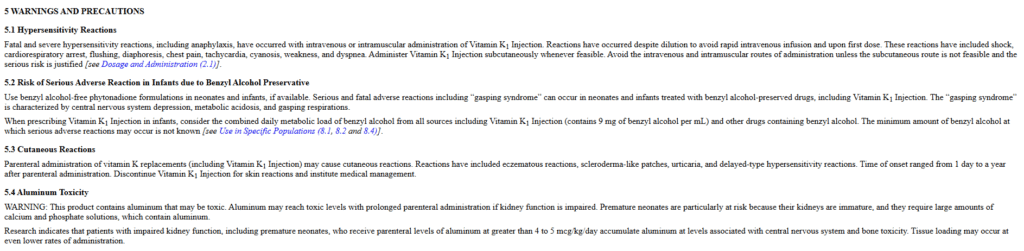
Black box warning states that IV and IM routes have been associated with reactions and that subcutaneous (SC) administration is preferred when possible.

Risk Factors
One source of vitamin K comes from gut bacteria, which help make small amounts of it. Antibiotics kill these bacteria, so when a baby is exposed to antibiotics (either directly or indirectly), they lose one of the few ways they can get vitamin K. Because newborns already start out low, this further drop in vitamin K increases the risk of bleeding, especially in the first week of life (classic VKDB)
Certain anticoagulants (especially warfarin and similar drugs) block an enzyme called vitamin K epoxide reductase (VKOR). This enzyme is needed to recycle vitamin K back into its active form. When it’s blocked Vitamin K is present but it cannot be activated or reused so clotting factors remain inactive.
Lovenox does not affect vitamin K and does not increase VKDB risk.
Precautions
Vitamin K injections may contain trace amounts of aluminum. not as an active ingredient. Black box warning has aliminum toxcicity warning.
Some manufacturers produce preservative-free or low-aluminum formulations of vitamin K. These versions are not always routinely stocked, but some hospitals can provide them if requested in advance, depending on availability.
https://labeling.pfizer.com/ShowLabeling.aspx?id=4669#section-5.4
Polysorbate 80 (also known as Tween 80) is a common non-ionic surfactant and emulsifier used in food, cosmetics, and medicine. In the context of the brain, it is famous for its unique ability to help drugs “sneak” through the Blood-Brain Barrier (BBB).
The Blood-Brain Barrier is a highly selective “security fence” of tightly packed cells that protects the brain by keeping out toxins and pathogens. However, this same fence prevents about 98% of potential brain medicines from reaching their target.
Researchers use Polysorbate 80 as a “coating” for nanoparticles to deliver medication into the brain.
A drug is placed inside a tiny nanoparticle, which is then coated with Polysorbate 80. Once in the bloodstream, the Polysorbate 80 coating attracts specific blood proteins called Apolipoproteins (specifically ApoE). The brain’s barrier sees these proteins and thinks they are healthy nutrients (like LDL cholesterol) that the brain needs. The barrier’s receptors “unlock” and pull the nanoparticle inside, effectively acting as a Trojan Horse to deliver the drug.
In most FDA-approved drugs that act on the brain (like antidepressants or antipsychotics), Polysorbate 80 is used in very small amounts as an “inactive ingredient” (excipient) to keep the liquid stable or help the pill dissolve. Usually ranges from 0.1% to 1.0% of the liquid volume.
Total Amount: For an injectable medication, this might be between 1 mg and 50 mg per dose.